Concept stageRenders onlyBench prototype next
Designed to read your tank through the wall.
A battery puck designed to stick on top of a plastic or fiberglass tank and measure the level through it with 60 GHz radar. No hole, no probe, nothing touching what’s inside.
Where this is today, 6 Oct 2026: the design and CAD exist, built to real part dimensions. No hardware is built yet. The bench test starts once the radar kit arrives.
Reservations aren’t open yet. When they open, $20 holds a unit and is refundable in full any time before your unit ships. ThruTank is a planned product and may not ship. No ship date.
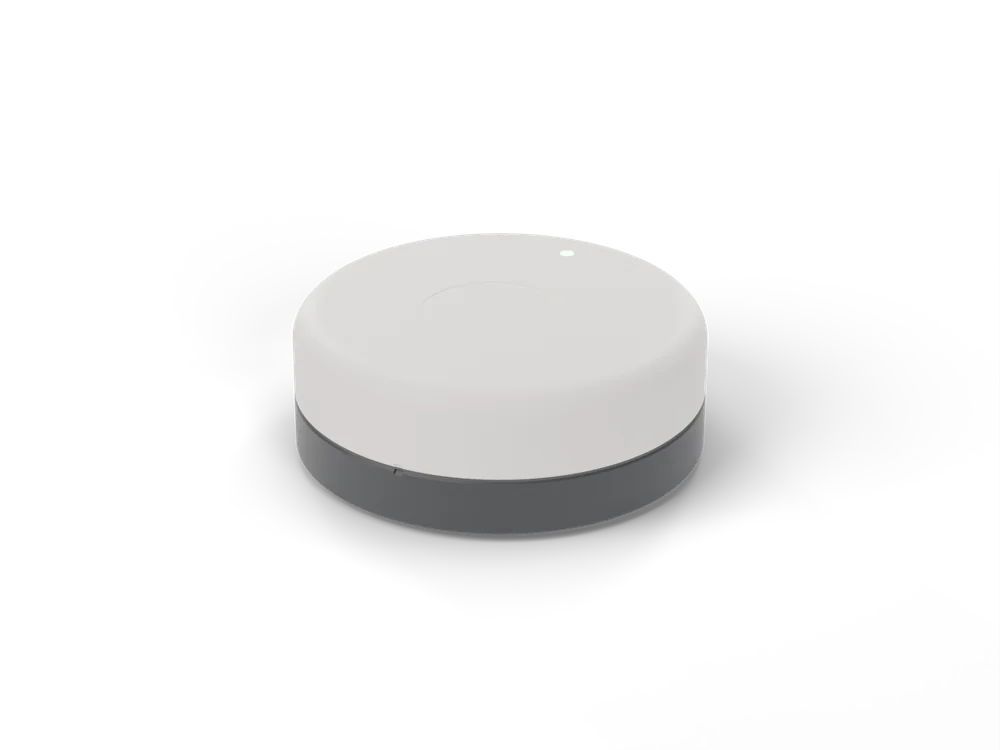 Ø 74 mm
28 mm
Ø 74 mm
28 mm
Concept render. Final design may change.
Ø 74 × 28 mm·2 × AA lithium·60 GHz
What owners say about the current options
From public forum threads about the sensors people use today. One quote, the rest paraphrased with links. Nobody here has used ThruTank; it doesn’t exist yet.
…with the copper tape on the plastic tank…never worked
After 16 gallons went in, an owner’s tank gauge read full. With the tank empty, it read two-thirds.
Paraphrased · r/RVLiving threadAn RV owner’s verdict on the stock probes that sit inside the tank: doomed to fail from day one.
Paraphrased · r/GoRVing threadSomeone who had already cut a hole in a tank for an ultrasonic sensor wished they had waited for a sensor that doesn’t need one.
Paraphrased · r/Victron, Jul 2026A full-timer of 21 years gave up on his tank sensors and tracks dumps on a post-it note.
Paraphrased · iRV2, 18 Nov 2025
How it’s designed to work
Radar at 60 GHz can pass through plastic and fiberglass. How much gets through depends on the wall’s material and thickness, which is exactly what the bench test measures. The puck times how long a pulse takes to bounce off the liquid and come back.
Why not ultrasound? Sound can’t cross the boundary between a plastic wall and air, so ultrasonic sensors need a hole in the top (Mopeka PRO200) or grease on the bottom (Mopeka Pro Check). Radar is designed to need neither.
- Radar, facing down
An Acconeer A121 chip on the underside of the board is designed to send short pulses through the puck’s base and the tank top.
- The tank wall
Poly or fiberglass. The radar is designed to pass through it; fiberglass and thick walls weaken the echo. Metal reflects radar, so metal tanks are out.
- The air gap
The echo’s round trip across the empty space gives the distance d.
- The liquid surface
Reflects the pulse. Level = tank depth − d. The app turns that into gallons for your tank’s shape.

Concept model built from the CAD at real component dimensions. Final design may change. 145 KB, loads only when you ask.
The concept model
Drag to turn it over. On a phone that supports AR, “See it at real size” places it at 1:1 scale, so you can hold it against your own tank top.
- Diameter74 mm
- Height28 mm
- Radar moduleAcconeer XM126
- Cells2 × AA lithium
- MountVHB foam ring
For the Home Assistant crowd
Under the hood
The planned firmware broadcasts BTHome v2, the open format Home Assistant decodes out of the box. No add-on, no cloud, no account. An ESPHome Bluetooth proxy extends the range like it does for any other Bluetooth sensor.
- Volume storage24.8 gal
- Distance121 mm
- Battery98 %
- Signal strength−71 dBm
# Planned firmware. Nothing to install: Home Assistant's
# built-in BTHome integration would discover the puck.
# Rename the device "ThruTank Fresh" to use this as-is.
alias: "Fresh water low"
triggers:
  - trigger: numeric_state
    entity_id: sensor.thrutank_fresh_volume_storage
    below: 8   # in the unit the entity shows
actions:
  - action: notify.notify
    data:
      message: >-
        Fresh tank at {{ states('sensor.thrutank_fresh_volume_storage') }}
        {{ state_attr('sensor.thrutank_fresh_volume_storage',
        'unit_of_measurement') }}. Fill up before you leave.
Victron GX: native support is planned, not available. Victron only shows sensors it has written a decoder for (Mopeka, Ruuvi, Safiery, Gobius C, SeeLevel). We’re applying, the way they did. Until Victron adds it, Victron owners can read the tank in our planned app or in Home Assistant.
The bench test we’ll publish
We’ll run this on camera with a tape measure in frame and post the raw readings.
Status: none of these has been run yet.
| Tank | Accuracy | Bad reads | Status |
|---|---|---|---|
| RV black tank, poly | ±1 cm Target | <5 % Target | Not run yet |
| 55-gal HDPE rain barrel | ±1 cm Target | <5 % Target | Not run yet |
| IBC tote | ±1 cm Target | <5 % Target | Not run yet |
| Fiberglass tank | ±1 cm Target | <5 % Target | Not run yet |
Also on camera
- Filling and draining in 5 cm steps
- Foam on the surface; a wet, condensation-covered lid
- Mounted near a wall and over a baffle
- Home Assistant discovering it over BTHome, then graphing it
- Measured current at one reading a minute, and the battery life that implies
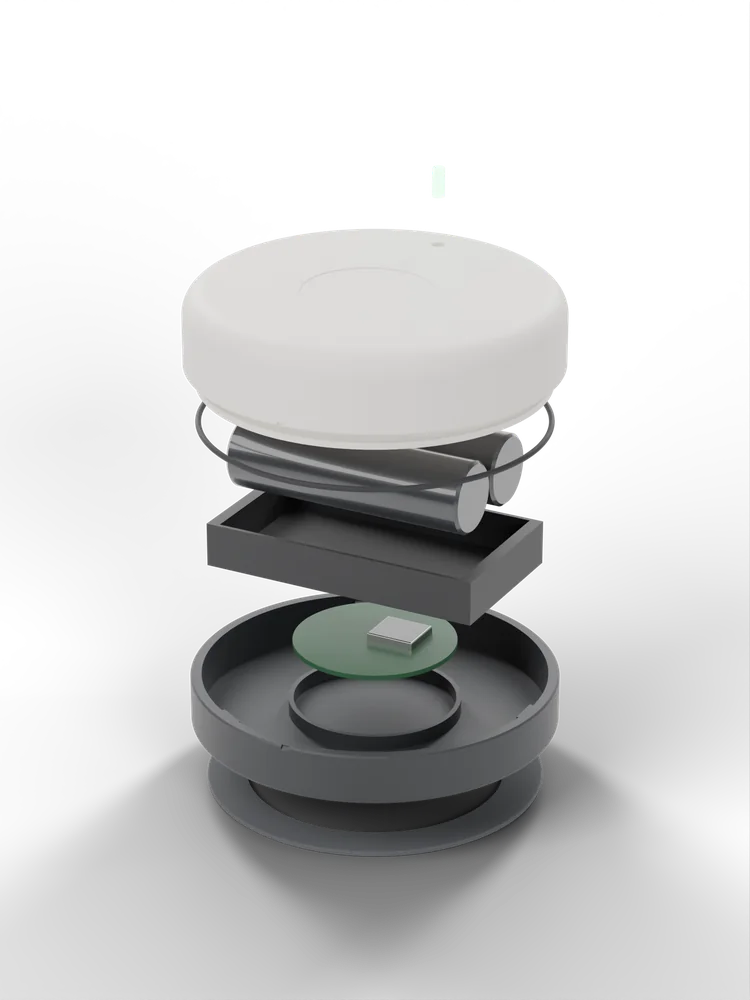
What’s inside
Seven parts. The radar board is an off-the-shelf module; the housing around it is where the work is.
- Light pipe
Carries a status light up to the top of the cap.
- Twist-off cap
Twist it off to change the cells. The base stays stuck to the tank.
- O-ring
Seals the cap to the base. Designed for IP66; not yet tested.
- 2 × AA lithium cells and holder
Lithium AAs are rated for cold. Target: 2 years or more at one reading a minute.
Energizer L91 class·−40 to +60 °C - Radar board
Acconeer’s XM126: the A121 60 GHz radar and a Nordic nRF52840 Bluetooth chip on one round board. The silver can on top is a metal shield; the radar chip sits on the underside, facing down.
XM126·Ø 33 mm·A121 + nRF52840 - Graphite base with radome floor
The floor under the radar is its window. Following Acconeer’s rule, its thickness is a half wavelength of 60 GHz inside the plastic, with the radar about 3 mm above it.
PC floor 1.5 or 3.0 mm·gap 3.0–3.5 mm - VHB foam ring
Sticks the puck to the top of the tank. Nothing drilled, nothing inside the tank.
Specs
As of 6 Oct 2026, nothing on this sheet is measured: no hardware is built yet. The bench test starts once the radar kit arrives. Component rows come from the published datasheets; the rest are design values and targets. Rows turn to “Measured” only after the bench test, with the conditions next to them.
Sensing
- Method
- 60 GHz pulsed coherent radar Datasheet
- Module
- Acconeer XM126 (A121) Datasheet
- Beam
- 53° × 65° Datasheethalf-power width, simulated by Acconeer
- Closest reading
- 3 cm below the sensor Vendor guideAcconeer tank-level app guide, not the module datasheet
- Reads through
- Poly, fiberglass Targetnot metal; to be bench tested
- Accuracy
- ±1 cm Target
- Bad reads
- <5 % Target
- Reading rate
- 1 per minute Design
Power
- Cells
- 2 × AA lithium Designuser-replaceable, twist-off cap
- Battery life
- ≥ 2 years Targetat 1 reading per minute
- Arithmetic
- ≈ 3.5 years Estimate0.29 mW average from datasheet figures, before cold and ageing; we’ll publish measured current
- Cell rating
- −40 to +60 °C DatasheetEnergizer L91
Connectivity
- Radio
- Bluetooth Low Energy (BLE), nRF52840 Datasheet
- Format
- BTHome v2 Targetplanned firmware
- Home Assistant
- Auto-discovered Targetbuilt-in BTHome integration, no add-on
- Victron GX
- Planned TBDneeds Victron to add a decoder; applying
- Phone app
- Tank-shape calibration Target
- Cloud, subscription
- None Design
Physical
- Size
- Ø 74 × 28 mm Design
- Mount
- VHB foam ring Designtop of the tank
- Sealing
- IP66 Targetnot tested
- Radar module temp.
- −40 to +85 °C Datasheet
- FCC
- Planned before shipping TBDthe module’s grant (2AQ6KXM002) is a limited modular approval, so the finished puck needs its own testing
What it won’t do
- Metal tanks. Radar can’t see through steel or aluminium. Poly and fiberglass only.
- Tanks you can’t reach from the top. It has to sit on the tank. Most under-floor RV black tanks are out.
- Victron native support: planned, not available. Use our planned app or Home Assistant until Victron adds it.
- Fuel tanks: not tested. We make no claim for diesel or petrol.
- No safety promise. It reports a level; it won’t stop an overflow.
Compared with what you use now
Prices as listed by the maker or a US dealer, all checked 6 Oct 2026, with links below. The others are shipping today; ThruTank isn’t.
Swipe the table sideways to see all seven.
| Feature | ThruTankconcept, estimates | Stock RV probescame with the RV | Garnet SeeLevel II709-BTP7, 3-tank kit | Mopeka Pro CheckUniversal, poly tanks | Safiery STAR-TankAustralia | Gobius CSweden | Simarine STR1Slovenia |
|---|---|---|---|---|---|---|---|
| How it senses | 60 GHz radar | Metal probes inside the tank | Capacitive strips on the tank’s side | Ultrasonic, from below | 60 GHz radar | Micro-radar | Radar |
| Mount | Top of the tank, VHB ring | Through the tank wall, touching the contents | Stuck on the side, wired to a replacement wall panel | Under the tank, with couplant grease | Top of the tank | Top of the tank | Top of the tank lid |
| Power | 2 × AA lithium (target ≥ 2 yr) | RV 12 V, wired | 12 V, wired | Battery | Battery, sealed (maker claims 3–5 yr) | Wired, 12–24 V | Wired, to an analog gauge |
| Through the wall? | Designed to: plastic, fiberglass. Not yet tested | No, needs holes | Yes, through the side | Yes, through the bottom | Yes: plastic, fiberglass | Yes: plastic, fiberglass, glass | Yes: through the plastic lid |
| Home Assistant | Planned: built-in BTHome | Not directly | No built-in integration | Yes, built-in (since 2023.2) | No built-in integration | No built-in integration | No built-in integration |
| Victron GX | Planned, not available | Not directly | Yes (added to Venus OS source Mar 2026) | Yes | Yes (added to Venus OS source Sep 2024) | Yes (added to Venus OS source Oct 2025) | Not in Victron’s sensor list |
| Shipping today | No. Concept stage | Yes | Yes | Yes | Yes | Yes | Yes |
| Price | est. $119founders est. $99 | $33.624 replacement probes (Valterra Horst Miracle Probe) | $144.95panel, harness and 3 tank sensors | $80.84+ $11.99 collar set for water and flat-bottom tanks | AUD 377.23inc. Australian GST (≈ AUD 343 ex-GST) | US$151–350Basic analog to NMEA 2000 | €84EU price inc. VAT; no US price listed |
- Stock-probe replacement: etrailer.com, Valterra T21301VP.
- SeeLevel II 709-BTP7 kit: recpro.com, RP-709-BTP7.
- Mopeka price, collar and mounting: mopeka.com. Home Assistant Mopeka integration: home-assistant.io.
- Safiery STAR-Tank: safiery.com.
- Gobius C: gobius.se webshop. Simarine STR1: simarine.net.
- Victron dates are when support was added to the Venus OS source (victronenergy/dbus-ble-sensors commits), not release dates. Cerbo GX manual.
- “No built-in integration” means none listed on home-assistant.io. All prices and pages checked 6 Oct 2026.
Price and reservations
All prices are estimates until the parts list and the first batch are quoted.
- ThruTankone puckest. $119founders est. $99
- 3-packfresh, grey, blackest. $299founders est. $269
- Reservationper unit, comes off the price$20refundable until it ships
Reservations aren’t open yet. We’ll open them once payments and refunds are set up and tested. Nobody can pay us anything before then.
When they open, $20 holds one unit from the first batch. The founders price covers the first 100 units. Want it back? Email thrutank@burakali.com and it’s refunded in full any time before your unit ships. You pay the rest only when your unit is ready.
ThruTank is in development. It is only planned and may not ship. If we don’t build it, every reservation is refunded in full. There is no ship date.
Get the bench results first
One email when the bench test is published, one when reservations open. Nothing else.
Thanks, you’re on the list.
- Next: we build the bench rig and run the test above on camera.
- You get one email when the numbers are in.
- And one when reservations open. The founders price covers the first 100 units.
Hard questions
The ones we’d ask, too.
Is this real? Can I buy one?
Not yet. ThruTank is at the concept stage: the CAD, the renders and the 3D model on this page are real, the hardware isn’t built. The next step is a bench prototype. It is a planned product and may not ship.
What happens to my $20?
Nothing yet, because reservations aren’t open and we take no money. When they open, $20 holds one unit from the first batch and comes off the price. You can get it back in full any time before your unit ships by emailing thrutank@burakali.com. If we don’t build ThruTank, every reservation is refunded.
When will it ship?
We don’t have a date and won’t make one up. First the bench test, then certification and a batch quote. We’ll only give a date once those are done, and we’ll email you if it moves.
Will it work on my tank?
ThruTank is designed for poly and fiberglass tanks you can reach from the top. It isn’t for metal tanks or for tanks you can only reach from below. The bench test above is where we measure it.
Does it work with Victron?
Not today. A Victron GX only shows Bluetooth sensors Victron has written a decoder for. STAR-Tank, Gobius C and SeeLevel each got one added; we’re applying the same way. Until then, read ThruTank in our planned app or in Home Assistant.
Isn’t this just an XM126 in a box?
Partly, and you can build your own: there is open-source BTHome firmware for the XM126. What we add is the part a weekend build skips: a housing whose floor is tuned as a radar window, AA power aimed at years of life, a mount that doesn’t need a drill, a calibration app for odd tank shapes, and someone in the US to send it back to.
Why trust a one-person company?
You don’t have to yet. There’s nothing to pay. Watch the bench results, read the numbers, and decide then. ThruTank is made by pebl health inc. in Baltimore, Maryland.
Why I’m building it
I’m Burak Unlu, a computer engineering student at Johns Hopkins in Baltimore. ThruTank is my own project, not a university one. It started in forum threads: RV owners who gave up on their tank sensors, Home Assistant users asking for a level sensor that works through plastic, and someone in r/Victron who had already cut a hole for a sensor and wished they’d waited.
Radar through a tank isn’t new. Safiery, Gobius and Simarine sell it today, and you can build one from an Acconeer kit. What I want to make is the version that runs on AA cells, sticks on, and shows up in Home Assistant by itself, at about $100 and supported from Maryland.
Right now it’s CAD and renders. Next is a bench rig: an XM126 kit, a rain barrel, a tape measure and a camera. I’ll publish what I measure.
Burak Unlupebl health inc., Baltimore, Maryland